Natural Tooth Preservation & Certified MINISH Dental Care in Magok, Seoul

Dental Guide
Inlay vs Onlay vs Crown: How to Choose a Restoration
Inlay vs onlay vs crown is decided by how many sound tooth walls survive and whether a cusp is involved. Here is the framework dentists use to choose.
Schedule a ConsultationInlay vs Onlay vs Crown: Choosing the Right Restoration for Tooth Damage
Medically reviewed by Dr. Park Hyo Jin, Specialist in Conservative Dentistry / Director
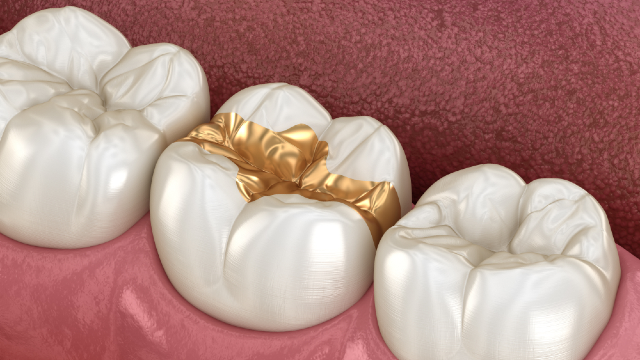
The inlay vs onlay vs crown question is answered by two measurements, not by preference: how many sound walls your tooth still has once the decay is cleared out, and whether any of its cusps — the raised chewing points on a back tooth — are involved. An inlay sits inside the walls and touches no cusp. An onlay takes over one or more cusps while leaving the rest of the tooth alone. A crown wraps everything. This guide sets out the thresholds that move a tooth from one category to the next.
The Three Options Side by Side
Here is the whole tooth restoration comparison in one view, with the clinical criteria that separate the three.
| Inlay | Onlay | Full crown | |
|---|---|---|---|
| What it covers | The cavity space between the walls | The cavity plus one or more cusps | The entire visible tooth |
| Cusps replaced | None | One or more, not all | All |
| Sound tooth removed to fit it | Least | Moderate — only over the cusps covered | Most; the whole outer surface is reduced |
| Typical damage pattern | Wide cavity, walls and cusps still solid | A cavity that has undermined a cusp, or a cusp already fractured | Several walls gone, or a cracked, structurally weakened tooth |
| How it is made | Outside the mouth, then bonded in | Outside the mouth, then bonded in | Outside the mouth, then fitted and bonded |
| Documented risks at this clinic | Sensitivity, marginal leakage, recurrent decay, fracture, loosening | Sensitivity, discomfort, loosening, fracture, recurrent decay | Sensitivity, gum irritation, bite discomfort, fracture or loosening, decay at the margin |
| When it is the right pick | The chewing surface needs rebuilding but no cusp is at risk | A cusp needs replacing and the remaining walls are thick enough to bond to | Too little wall is left for partial coverage, or the tooth needs holding together |
Notice that the healthy tooth sacrificed rises with each step, which is why the decision matters. Notice too that gum irritation appears only on the crown list, because a crown margin sits at or near the gumline.
A 2025 scoping review in the Journal of Esthetic and Restorative Dentistry names a fourth option you may hear about. It describes partial coverage restorations as an umbrella category for restorations with partial cusp coverage, distinguished from inlays, which cover no cusp, and overlays, which cover all of them. An overlay therefore sits between an onlay and a crown.
The Measurement That Actually Decides It: How Much Wall Is Left
The single strongest predictor is the quantity, thickness, and position of the sound tooth structure remaining after all decay and cracked material has been removed.
A systematic review published in Cureus in October 2025 looked specifically at how remaining tooth structure changes the prognosis of restored back teeth. It included five clinical studies, with individual studies following between 105 and 420 teeth. Its findings map almost directly onto the three-way choice:
- Teeth that had lost one to three surfaces and still had their axial walls — the vertical sides — performed well with adhesively bonded restorations that did not cover the cusps.
- Teeth that had lost four to five surfaces, or whose ferrule was disrupted, did better with cuspal coverage. A ferrule is the continuous band of solid tooth wall that a restoration can grip.
- Remaining dentin thickness below about 1 millimeter raised the risk of failure, and the review singled out the interproximal areas — the surfaces between neighboring teeth — as the most critical.
- The location of the missing walls mattered, not just how many were gone.
That last point is the least intuitive. Two teeth can each be missing two walls and still need different restorations, because losing both walls on the same side is mechanically very different from losing one on each side.
The review also reported a timing effect: at 36 months or less, several studies recorded 100 percent survival for both crowns and non-covering restorations. Differences opened up only at roughly eight to ten years, where crowned teeth generally survived better — mainly the teeth whose structural loss had been extensive.
Where an Inlay Stops and an Onlay Begins
The onlay vs inlay difference is the presence or absence of a cusp in the restoration, and the clinical trigger is a cusp that can no longer be trusted to survive on its own.
A cusp becomes questionable for a few reasons your dentist can assess:
- The cavity has cut underneath it. When decay removal leaves a cusp standing on thin, unsupported dentin, that cusp is a fracture waiting to happen. Covering it converts a risky wedge of tooth into part of the restoration.
- The cusp is already cracked or chipped. A fracture line running into a cusp usually means an onlay at minimum.
- The preparation crosses too much of the chewing surface. Once the channel through the middle of the tooth is wide relative to the distance between the cheek-side and tongue-side cusp tips, the cusps flex apart under load rather than staying rigid.
- The tooth has been opened for root canal treatment. Access through the chewing surface removes structure from the inside, changing how the walls behave.
None of this can be judged from the outside of the tooth alone, because the visible opening is often smaller than the cavity beneath it. Many adults also reach this decision on a tooth that already carries an older restoration: the National Institute of Dental and Craniofacial Research, part of the National Institutes of Health, records that US adults averaged 8.6 decayed, missing, and filled teeth in the 2017 to March 2020 survey period.
When a Full Crown Is the Better Choice
There are situations in which a crown is not the over-treatment option but the correct one, and it is worth being direct about them.
A crown becomes the reasonable choice when:
- Four or more surfaces are gone, or the band of solid wall around the tooth is broken, following the pattern the Cureus review associated with better outcomes under cuspal coverage.
- The remaining walls are thinner than roughly a millimeter in the areas that carry load, so there is not enough dentin for a partial restoration to bond to reliably.
- A crack runs across the tooth and the restoration's job is to hold the segments together rather than to fill a space.
- A previous large restoration has already consumed the structure a partial-coverage design would have relied on, or the tooth is a molar under heavy load in someone who clenches or grinds.
The long-term record for full-coverage restorations is genuinely strong. A systematic review and network meta-analysis published in the Journal of the American Dental Association in 2020 examined treatment options for large cavities in back teeth, screening 11,263 records and including 43 studies. It reported annual failure rates of 0.29 percent for gold crowns and 0.52 percent for metal-ceramic crowns, against 2.19 percent for direct resin composite, and its ranking probabilities favored those two crown types among the indirect options.
Root-treated back teeth are the clearest case for coverage. A review of the clinical literature on restoring root filled teeth, published in the International Endodontic Journal in 2021, reported enhanced survival for posterior teeth restored with cuspal coverage after root canal treatment. It cited a study of 1,273 root filled teeth in which cuspal coverage significantly improved long-term survival, and noted that direct and indirect restorations performed alike at five years while indirect restorations pulled ahead at ten. Note that "cuspal coverage" includes an onlay — the finding argues for covering the cusps, not necessarily for wrapping the whole tooth.
What the Evidence Says About Partial Coverage
Partial-coverage restorations are not a compromise chosen for lack of anything better; the evidence supports them within their indications.
A systematic review and meta-analysis in the Journal of Esthetic and Restorative Dentistry pooled six randomized controlled trials of ceramic and ceramic-based partial-coverage restorations on posterior teeth. At three years it reported survival of 89.3 percent for resin-matrix ceramic restorations and 93.7 percent for lithium disilicate, with 95 percent confidence intervals of 76.4 to 95.3 and 83.7 to 97.7 respectively. The authors concluded these are a reliable option for restoring extended defects in back teeth.
Professional opinion has moved in the same direction. An interdisciplinary Delphi consensus study by PROSEC North America, published in the same journal in 2025, took a multidisciplinary panel through three consensus workshops supported by a systematic search of five databases. Its recommendations were that the choice between direct and indirect restorations should be made case by case, and that inlays and onlays should be favored over crowns to align with minimally invasive principles. The panel also stressed that the result depends on execution — precision in preparation, impression taking, contamination control, and luting.
The message is not that partial coverage always wins. It is that partial coverage should be the default when the tooth structure supports it, and that technique matters as much as the category chosen.
A Decision Path You Can Follow With Your Dentist
This is the sequence the choice usually follows, so you can ask where your own tooth sits.
- Remove everything that has to go. Decay, cracked enamel, and any failing old restoration come out first. Only then is the remaining structure measurable.
- Count the walls, check the ferrule, and measure thickness. How many surfaces are gone, where are they, is there a continuous band of solid tooth left, and how thick is it in the load-bearing areas?
- Assess each cusp individually. An undermined or cracked cusp needs covering; a solid, well-supported one does not.
- Factor in the tooth's history. Root canal treatment, previous large restorations, and existing cracks all reduce the reserve available.
- Factor in the load. Molars, a heavy bite, and a grinding or clenching habit all argue for a more protective design.
- Choose the lowest rung that the findings support — direct filling, inlay, onlay, overlay, or crown — and select a material suited to that design.
- Plan the maintenance. Every one of these restorations has a margin where restoration meets tooth, and every margin needs daily cleaning and periodic review.
Material Choice Is Part of the Coverage Decision
The material and the coverage design are chosen together, because not every material behaves well in every design. The American Dental Association's overview of materials for indirect restorations sets out the categories and their indications:
- High noble and noble alloys, including gold. Indicated for inlays, onlays, crowns, and bridges. Advantages are flexural strength, durability, and hardness; disadvantages are cost and appearance, with anterior teeth listed as a contraindication.
- All-ceramic materials. Indicated for inlays, onlays, crowns, and aesthetic veneers, with excellent appearance and high-stress areas as a contraindication depending on the material.
- Resin-based composite. Indicated for inlays, onlays, and long-term temporary restorations, with high stress a contraindication and wear and discoloration as disadvantages.
- Base metal alloys and metal-ceramics. Indicated for crowns and bridges rather than partial-coverage work.
The survival figures the ADA compiles show why restoration material comparison is not settled by strength alone. Cast gold inlays and onlays had the lowest annual failure rate — 1.4 percent — in a 2010 review of posterior restoration longevity. Lithium disilicate and leucite-reinforced ceramics recorded an annual failure rate of 0.69 percent and five-year survival of 96.6 to 97.4 percent. Zirconia showed five-year survival of 91.2 to 98.5 percent, but one retrospective cohort saw that drop to 67.2 percent at 10 years in molars.
In a 2021 ADA Clinical Evaluators Panel survey of 277 dentists, zirconia was used for posterior crowns by 98 percent of respondents but for onlays by only 12 percent and inlays by 6 percent — a reminder that a very strong ceramic is not automatically the right choice for a partial-coverage design.
Why the Plan Can Change Once Treatment Starts
A recommendation made before treatment is a well-informed estimate, and it is normal for it to be revised.
Imaging reveals a great deal, but it does not measure the thickness of a wall that has not yet been cleaned out. The honest sequence is that the dentist proposes the most likely restoration, removes the diseased tissue, and then confirms or revises. A tooth planned for an inlay may need an onlay because a cusp turns out to be undermined. A tooth planned for an onlay may need a crown because a crack extends further than expected. It also runs the other way: a tooth referred for a crown sometimes proves restorable with less coverage.
Ask about this in advance rather than discovering it mid-appointment. Two questions cover it:
- If more damage is found than expected, what is the fallback restoration, and would it change the number of appointments or the material?
- How will the revised plan and its reasoning be documented for me?
How Magok Pureunmaeum Dental Clinic Documents These Three Options
The clinic lists all three as separate named services under its Prosthetic Restoration specialty, one of eight documented specialties spanning 16 listed services, and the candidate criteria it publishes for each one track the framework above.
| Service | Documented candidates | Documented alternatives |
|---|---|---|
| Inlay Restoration | Moderate decay or damage restorable without a full crown | Direct filling, onlay, or crown |
| Onlay Restoration | Moderate damage, decay, or weakened structure where sufficient healthy tooth remains | Direct filling, inlay, crown, or other restorative treatment |
| Crown Restoration | Significantly damaged, weakened, or extensively decayed teeth that a simple filling cannot adequately restore | Filling, inlay or onlay, veneer, or extraction followed by tooth replacement |
Its documented exclusions run the same way: extensive structural damage may make a tooth unsuitable for an inlay or an onlay, and untreated infection may need treating before any prosthetic restoration. An onlay may also require more than one visit when the restoration is fabricated outside the mouth.
For diagnosis, the clinic documents 3D CT imaging and an advanced digital diagnostic system in clinic-wide use, and states that its approach to reducing risk rests on that digital diagnosis together with a preservation-first stance in which options for keeping the tooth are evaluated before extraction or invasive treatment. Its published philosophy is to preserve natural teeth as much as possible while meeting patients' aesthetic goals, and to perform only treatments that are truly necessary.
Restorative planning falls to Dr. Park Hyo Jin, the Director. She is a licensed dentist in South Korea and a board-recognized specialist in Conservative Dentistry. She holds a Master's Degree in Dentistry from Wonkwang University Graduate School and completed an internship and residency in Conservative Dentistry. She has over 22 years of clinical experience. She is a full member of the Korean Academy of Conservative Dentistry, the Korean Academy of Endodontics, and the Korean Academy of Esthetic Dentistry. These are Korean qualifications and memberships; Korean specialist registration is not equivalent to United States board certification.
The clinic has operated since 2017 and does not provide orthodontics or dentures. Background on the practice is on its about-us page.
Practical Questions if You Are Planning Treatment From the US
If you are weighing restorative dentistry options in Korea, the coverage decision has logistical consequences worth settling before booking flights.
The clinic is on the 3rd floor of Woosung SB Tower, 385 Gangseo-ro, Gangseo-gu, Seoul 07586, about 50 meters from Exit 2 of Balsan Station on Seoul Metro Line 5. Hours are 9:30 AM to 6:30 PM KST on Monday and Wednesday through Friday, 9:30 AM to 8:30 PM on Tuesday, and 9:30 AM to 2:00 PM on Saturday; it is closed Sundays and public holidays. US patients typically arrive at Incheon (ICN) or Gimpo (GMP). The clinic is a Registered Medical Institution for Attracting Foreign Patients under Korea's Ministry of Health and Welfare, in compliance with the Medical Overseas Expansion and Foreign Patients Attraction Act — a government registration permitting treatment of international patients, not a clinical quality rating. It states there are no language limitations, and describes interpreter arrangements as determined after consultation.
No prices appear here, because the clinic's pricing is not published and any figure quoted before an examination would be guesswork. The cost drivers to ask about are:
- How many teeth are involved, and which restoration each one needs.
- Whether preliminary treatment — decay removal, gum treatment, or root canal therapy — comes first.
- Which material is proposed for each restoration and why.
- How many appointments the plan needs, and whether they fit one trip.
- What follow-up or remake terms apply if a problem appears after you fly home. Support for international patients after they return is not documented publicly, so ask directly and get the answer in writing.
You can raise all of this through the clinic's consultation contact page before committing to dates.
The Bottom Line
- The choice is driven by remaining wall count, wall thickness, and cusp involvement — not by preference or by the size of the visible cavity.
- A 2025 Cureus systematic review found that teeth losing one to three surfaces with intact axial walls did well without cuspal coverage, while teeth losing four to five surfaces or with a disrupted ferrule benefited from coverage, and that dentin thinner than about 1 millimeter raised failure risk.
- Partial coverage has real evidence behind it: pooled randomized trials reported three-year survival of 93.7 percent for lithium disilicate and 89.3 percent for resin-matrix ceramic restorations, and a 2025 PROSEC North America consensus panel recommended favoring inlays and onlays over crowns where the tooth allows.
- Crowns remain the better answer for structurally compromised teeth, with annual failure rates of 0.29 percent for gold and 0.52 percent for metal-ceramic crowns in a 2020 JADA network meta-analysis.
- The final call is often made after the decay is removed, so agree on the fallback plan beforehand.
Frequently Asked Questions
If a dentist recommends a crown, is it fair to ask about an onlay instead?
Yes, and there is professional support for asking. The 2025 PROSEC North America Delphi consensus recommended favoring inlays and onlays over crowns in keeping with minimally invasive principles, and choosing between direct and indirect restorations case by case. The useful phrasing is to ask what specifically rules out partial coverage on your tooth — how many walls are missing, and how thick the remaining ones are.
Does an onlay require more tooth removal than an inlay?
Yes, but only in the specific area being covered. An onlay reduces the cusp or cusps it will replace, while leaving the rest of the tooth's outer surface alone. A crown, by contrast, reduces the whole circumference. That is why the three form a ladder rather than three unrelated options.
How many walls does a tooth need for an inlay to be reasonable?
There is no single number that applies to every tooth, because position and thickness matter as much as count. The Cureus systematic review found that teeth with one to three surfaces lost and preserved axial walls did well with restorations that did not cover the cusps, while four to five surfaces lost pointed toward coverage. It also flagged remaining dentin thinner than about 1 millimeter, especially between the teeth, as a risk factor regardless of the count.
Do I need a crown after a root canal on a back tooth?
A back tooth that has had root canal treatment usually needs its cusps covered, though that can mean an onlay rather than a full crown. The 2021 International Endodontic Journal review reported enhanced survival for posterior root filled teeth restored with cuspal coverage, and found that teeth restored with coverage within four months of completing the root canal were three times less likely to be extracted than those restored later. The specific design still depends on how much wall the access opening and the original decay left behind.
Does grinding my teeth at night rule out an inlay or onlay?
It does not automatically rule them out, but it is a real factor in the decision. The ADA notes that high-stress areas are a listed contraindication for all-ceramic materials depending on the specific material, and a contraindication for indirect resin-based composite. Tell your dentist about clenching or grinding before the material is chosen, and ask whether a protective night appliance should be part of the plan.
If an onlay fails later, can it be replaced with a crown?
Usually yes, because a crown covers more of the tooth than an onlay does, so the structure prepared for an onlay generally remains available. That is part of the logic behind starting at the lowest workable rung: it keeps the more extensive option in reserve. The reverse is not true, which is why a crown placed on a tooth that did not need one cannot be undone.
This article is for general informational purposes and does not constitute individualized medical advice, and it is not a self-diagnosis tool. Treatment candidacy, technique, and expected outcomes can only be determined through a consultation with a qualified dentist.
More Articles
Continue reading clinical guides from our dental specialists.

Cavity Treatment Korea: Resin Filling vs Inlay or Crown
A resin restoration is usually enough when decay is small and the tooth's walls and cusps are intact. Larger damage points to an inlay, onlay, or crown.
Learn More

Inlay Onlay Dental Restoration vs Crown: How to Choose
An inlay or onlay restores a damaged tooth without full coverage. Published data show partial-coverage survival close to crowns, so choose by tooth left.
Learn More

Minish Dental Treatment: How It Preserves Tooth Structure
Minish dental treatment is a biomimetic restoration that rebuilds damaged teeth with precision-made blocks while removing as little enamel as possible.
Learn More