Natural Tooth Preservation & Certified MINISH Dental Care in Magok, Seoul

Dental Guide
Extraction vs Root Canal: When a Tooth Can Be Saved
Extraction vs root canal comes down to restorability: how much sound tooth remains, whether the root is intact, and how healthy the supporting bone is.
Schedule a ConsultationExtraction vs Root Canal: When Saving the Natural Tooth Is Possible
Medically reviewed by Dr. Park Hyo Jin, Specialist in Conservative Dentistry / Director
The extraction vs root canal decision usually turns on one question: is there enough sound tooth left to rebuild, and can the root and supporting bone carry it afterward? When the answer is yes, root canal treatment is generally the option that keeps your own tooth working. When the answer is no — an unrestorable fracture, decay well below the gum line, advanced bone loss — extraction is the reasonable choice. This guide explains how that judgment is made, what the outcome data supports, and what to ask at the consultation.
What Each Option Actually Does
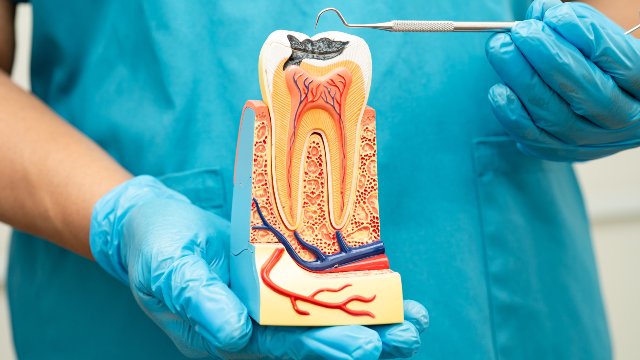
The two treatments answer different findings, so it helps to separate them before comparing them. Root canal treatment belongs to endodontics, the branch of dentistry concerned with the pulp inside the tooth and the tissues around the root. The American Association of Endodontists describes the sequence plainly: the inflamed or infected pulp is removed, the inside of the tooth is cleaned and disinfected, then filled and sealed with a rubber-like material called gutta-percha, after which the tooth is restored with a crown or filling.
Extraction removes the entire tooth, root included. The American Dental Association's patient guidance notes that the area is numbed first, that a small amount of bleeding afterward is normal, and that the mouth slowly fills in the bone where the tooth root was through the formation of a blood clot. Extraction ends the problem in that tooth permanently, and it also starts a second decision — whether and how to replace the gap.
At Magok Pureunmaeum Dental Clinic in Gangseo-gu, Seoul, both paths exist under one roof. Conservative Dentistry and Endodontics is the service line focused on preserving natural teeth and treating disease of the pulp and root canals. Oral and Maxillofacial Surgery is a separate specialty there covering surgical care, including difficult extractions, with Dr. Park Kyung Ran as the specialist.
The Real Question Is Restorability, Not Pain Level
Whether a tooth can be saved depends mostly on what is left to build on, not on how much it hurts. A tooth can ache severely and still be entirely restorable, and it can feel like nothing at all and still be beyond repair. Four structural questions drive the assessment:
- How much solid tooth remains above the gum line. A crown needs a continuous band of sound tooth around its margin to grip. When decay or an old fracture has eaten through that band, the restoration has nothing reliable to hold.
- Whether the remaining walls are intact. A tooth missing one or two surfaces behaves very differently from a tooth reduced to a shell.
- Whether the root itself is sound. A crack that stops in the crown is a different problem from one that travels down into the root.
- How deep the damage runs below the gum. Decay that extends well under the gum and bone may be impossible to clean, seal, and keep clean.
There is hard evidence that the restoration stage decides many of these cases. In an eight-year study published in the Journal of Endodontics, Salehrabi and Rotstein examined initial root canal treatment in 1,462,936 teeth from more than a million patients across all 50 US states. Among the teeth eventually extracted, 85% had no full coronal coverage — no crown or comparable restoration protecting them.
That does not mean every root-canal-treated tooth needs a crown. A Cochrane systematic review of crowns versus conventional fillings for root-filled teeth found only one small trial and concluded there is insufficient evidence to say which performs better. The practical takeaway is narrower: a plan to save the tooth is only complete when it also says how the tooth will be sealed and protected afterward.
Root Canal Treatment vs Extraction, Side by Side
Here is the comparison in the terms that actually differ. Neither column is the better option in the abstract.
| Consideration | Root canal treatment and restoration | Extraction and replacement |
|---|---|---|
| What happens to the tooth | The natural root and crown stay in place; only the pulp is removed | The whole tooth, root included, is removed |
| Reversibility | Further options remain later, including retreatment or surgery | Permanent for that tooth |
| What follows | A filling, inlay, onlay, or crown to seal and protect the tooth | Socket healing, then a decision about an implant, a bridge, or leaving the gap |
| Effect on neighbors | The tooth keeps holding its position in the bite | The AAE notes missing teeth can cause other teeth to shift and affect chewing |
| Bone and gum | Existing root and surrounding bone are preserved | Bone fills the socket; volume can change, and grafting is sometimes needed later |
| Comfort | The AAE states patients are six times more likely to describe root canal treatment as painless than patients who have a tooth extracted | Recovery involves clot protection, dietary care, and avoiding smoking and straws |
| Where it fits best | Restorable tooth, intact root, treatable supporting tissue | Unrestorable tooth, fractured root, or support that cannot be stabilized |
When Root Canal Treatment Is the Stronger Choice
Root canal treatment is usually the better option when the tooth still has a job to do and the structure to do it. The AAE's position for patients is direct: nothing looks, feels, or functions like your natural tooth, and when given a choice between extraction and root canal treatment, it advises opting for the root canal, because no denture, bridge, or implant will look, feel, and function as well as a natural tooth. The specific conditions that favor saving the tooth:
- Enough sound tooth structure remains above and just below the gum line to support a restoration.
- The root is intact, with no crack extending into it.
- The gum and bone around the tooth are healthy, or treatable to a stable condition.
- The canal system can be reached, cleaned, and sealed.
- Decay, if present, can be fully removed while leaving a restorable tooth behind.
- The tooth has a real function in your bite — it takes chewing load, holds a neighbor in place, or supports an existing restoration.
- Your general health and oral hygiene support healing and long-term maintenance.
Magok Pureunmaeum Dental Clinic's stated philosophy sits on this side of the line: preserving natural teeth as much as possible while meeting patients' esthetic needs. Its periodontal service line uses the same language, describing a natural tooth preservation philosophy focused on preserving natural teeth rather than unnecessary extractions or premature implants.
When Extraction Is Genuinely the Right Call
Some teeth cannot be saved, and a plan that pretends otherwise costs you time, money, and comfort without changing the outcome. Extraction is the appropriate treatment, not a fallback, in situations like these:
- A fracture that cannot be restored. When a crack travels below the gum line into the root, there is no way to seal the tooth against bacteria or give a restoration a stable base.
- Decay that has destroyed the restorable tooth. If sound structure ends below the gum and bone, a crown has nothing to grip and the margin cannot be kept clean.
- Severe periodontal bone loss. The ADA notes that periodontal disease can destroy tooth-supporting structures and lead to tooth loss, and that surgical periodontal treatment includes extraction of teeth that cannot be successfully treated.
- Advanced-stage disease with functional collapse. In the staging system published by the American Academy of Periodontology and the European Federation of Periodontology, Stage IV periodontitis includes tooth mobility of degree 2 or higher, masticatory dysfunction, bite collapse, and fewer than 20 remaining teeth. Teeth in that setting are sometimes better removed as part of a broader plan.
- A treated tooth whose problem keeps returning with no correctable cause. If retreatment has already been done and the prognosis is poor, another attempt may not be the best use of the remaining structure.
- A tooth that cannot be maintained. A tooth that can technically be treated but cannot realistically be cleaned and followed up may be a poor long-term bet.
Extraction also has genuine advantages worth naming. It resolves infection in that tooth definitively, it is usually a shorter course of treatment than rebuilding a badly damaged tooth, and it clears the way for a planned replacement rather than a series of repairs on a tooth that keeps failing.
A Practical Decision Framework
Six checks, in this order, settle most cases. Each has a favorable answer and an unfavorable one, and a single clearly unfavorable answer can decide the question.
- Structure. Is there a continuous band of sound tooth for a restoration to seal against? Favorable: yes, at or above the gum. Unfavorable: sound tooth ends deep below the gum.
- Root integrity. Is the root free of cracks? Favorable: intact root on examination and imaging. Unfavorable: a fracture line running into the root.
- Periodontal support. How much bone and attachment remain, and is the tooth stable? Favorable: pockets that respond to treatment. Unfavorable: advanced bone loss with significant mobility.
- Access. Can the canal system be reached and cleaned? Favorable: negotiable canals on imaging. Unfavorable: a blockage or anatomy that cannot be treated.
- Strategic value. What does this tooth do for you? Favorable: it carries chewing load or anchors a restoration. Unfavorable: it contributes little and complicates the plan.
- Maintainability. Can the finished result be cleaned and followed up? Favorable: good hygiene and realistic follow-up.
The clinic's documented process matches this shape: the dentist examines the tooth and uses dental imaging before selecting treatment, and suitability depends on tooth condition, remaining tooth structure, infection, periodontal status, and overall oral health. Three-dimensional imaging supports the harder calls, and the clinic lists 3D CT imaging plus one publicly listed cone beam CT unit.
What the Outcome Data Supports
Saved teeth do well as a group, which is the strongest single argument for trying first. In the Journal of Endodontics study described earlier, 97% of teeth were still in the mouth eight years after initial nonsurgical root canal treatment. The combined incidence of untoward events — retreatments, root-end surgery, and extractions — was 3%, and most occurred within three years of treatment. The authors called initial nonsurgical endodontic treatment a predictable procedure with a high incidence of tooth retention.
Two cautions belong beside that number. It describes a population, not your tooth; a molar with one wall left is not represented by the average. And it measures retention, not perfection — a retained tooth may still have needed additional work along the way.
A systematic review in the International Dental Journal pooled 4,396 extractions and found caries accounted for 36.0% to 55.3% of them, periodontitis for 24.8% to 38.1%, periapical disease for 7.3% to 19.1%, and trauma for 0.8% to 4.4%. In other words, most teeth are not removed because of a dramatic event. They are removed because decay or gum disease reached a point where restoration was no longer possible — which is also why the size and depth of the damage matters more in this decision than the intensity of the symptoms.
The same review noted that between 3.6% and 5.9% of extractions were recorded as patient requests rather than clinical indications, and that the final decision rests with the dentist or oral surgeon, who should not remove a tooth without dental necessity.
If Extraction Is the Answer, What Comes Next
Extraction is one decision; replacement is a separate one, and it deserves its own conversation rather than a reflex. For context, NIDCR data from the National Health and Nutrition Examination Survey show US adults aged 20 to 64 retain an average of about 25.5 permanent teeth, and roughly 2% have no natural teeth remaining.
At Magok Pureunmaeum Dental Clinic, dental implants are the documented replacement path. Implant planning begins with panoramic X-rays alongside a 3D CT scan to evaluate jawbone density, nerve pathways, blood vessels, and adjacent tooth roots. The clinic describes performing extraction and implant placement in a single day when bone conditions allow, and using custom abutments shaped to the individual gum line to reduce food impaction. Where bone volume is insufficient, bone grafting or a sinus lift may be needed first, which adds healing time before placement.
Two honest notes on this path. Replacement takes more appointments than saving a tooth usually does, and traditional implant treatment requires several months for the jawbone to integrate with the fixture. And the clinic does not provide orthodontics or dentures, so a plan involving either would need to be arranged elsewhere.
Asking for a Second Opinion Is a Normal Step
Wanting a second view on an extraction recommendation is ordinary, and it does not imply that the first dentist was careless. Two clinicians can look at the same tooth, weigh restorability and long-term maintenance differently, and each give defensible advice. The AAE's own patient guidance builds this into the process: if your dentist recommends extraction, ask whether a root canal is an option, and if you are told it is not, ask why and request a referral to a specialist.
Useful questions, whether you ask them of the first dentist or a second one:
- What specifically makes this tooth unrestorable — the amount of structure, a fracture, the bone support, or access to the canals?
- Can you show me on the image where that finding is?
- If we try to save it, what is the plan for restoring and sealing it afterward?
- If we save it and it fails, what have I lost compared with extracting it now?
- If we extract it, what is the replacement plan, and what does the timeline look like?
Bring previous radiographs of that tooth, treatment notes, and dates of earlier work; a history makes a second assessment more useful than a fresh look alone. Translated documents are available, per the clinic, and multilingual support covers all patient services, with interpreter arrangements set after consultation.
How This Clinic Approaches the Save-or-Extract Question
Who evaluates the tooth matters, because this is a diagnostic decision before it is a technical one. The clinic's director, Dr. Park Hyo Jin, is a Specialist in Conservative Dentistry. She is licensed as a dentist in South Korea, and her board-recognized specialty status in Conservative Dentistry is a Korean registration rather than a US board certification. She holds a Master's degree in Dentistry from Wonkwang University Graduate School, and she completed internship and residency training in Conservative Dentistry at Wonkwang University Dental Hospital. She has over 22 years of clinical experience, with restorative dentistry and root canal treatment among her listed core specializations. She holds full membership in the Korean Academy of Conservative Dentistry, the Korean Academy of Endodontics, and the Korean Academy of Esthetic Dentistry.
Her stated philosophy is to design every treatment plan with the mindset of treating one's own family, prioritizing preservation of natural teeth and performing only treatments that are truly necessary. More on the practice's history and mission sits on its about us page.
The clinic was established in 2017 and sits on the 3rd floor of Woosung SB Tower, 385 Gangseo-ro, Gangseo-gu, Seoul 07586, about 50 meters from Exit 2 of Balsan Station on Seoul Metro Line 5. Consultation hours are Monday and Wednesday through Friday, 9:30 AM to 6:30 PM KST; Tuesday, 9:30 AM to 8:30 PM KST; and Saturday, 9:30 AM to 2:00 PM KST with no lunch break, and it is closed on Sundays and public holidays. It is a Registered Medical Institution for Attracting Foreign Patients certified by the Korean Ministry of Health and Welfare under the Medical Overseas Expansion and Foreign Patients Attraction Act — a Korean government registration, not a quality accreditation.
Weighing This From the United States
If you are considering treatment in Korea, three practical items shape this decision more than anything else on the itinerary. The clinic documents that US patients typically fly into Incheon (ICN) or Gimpo (GMP), and advises confirming current Korean entry requirements, including K-ETA rules, before travel.
- Sequence. A tooth that can be saved and restored may fit a shorter trip than an extraction followed by implant treatment, which the clinic describes as ranging from single-day options to multi-visit care over months in complex bone cases. Ask which applies before booking flights.
- Records. Bring or forward radiographs and notes for the tooth in question.
- Follow-up. This is the honest weak point of dental travel. The clinic's aftercare arrangements for international patients are not published, so ask in writing who reviews a problem that appears after you get home, how records are shared with a dentist in the US, and what a revision would involve. You can start that conversation through the clinic's online consultation and contact page.
On cost, this article carries no figures. What moves a plan is the shape of the treatment: whether the tooth is saved or replaced, how many canals it has, whether the restoration is a filling or a full crown, whether periodontal treatment or bone grafting is needed, and how many visits and trips are involved. The clinic documents cost transparency as a frequent US-patient concern and sets treatment plans after an in-person examination. Ask for an itemized written estimate, and ask what happens if the findings change the plan mid-treatment.
The Bottom Line
- The extraction vs root canal question is decided by restorability — remaining sound structure, an intact root, treatable gum and bone support, and access to the canals — not by how much the tooth hurts.
- Saved teeth do well as a group: 97% were still in the mouth eight years after initial root canal treatment in a study of more than 1.4 million teeth, though group data never promises an individual result.
- How the tooth is sealed afterward matters; among teeth extracted after root canal treatment in that study, 85% had no full coronal coverage.
- Extraction is genuinely correct for an unrestorable fracture, decay below restorable limits, advanced periodontal bone loss, or a retreated tooth with a poor prognosis.
- Magok Pureunmaeum Dental Clinic states a natural-tooth-preservation philosophy and provides both conservative endodontic care under Dr. Park Hyo Jin and surgical care under Dr. Park Kyung Ran.
Frequently Asked Questions
My tooth does not hurt. Does that mean it can still be saved?
Not necessarily, in either direction. Absence of pain does not confirm the tooth is restorable, because a pulp can die quietly and decay can spread below the gum without symptoms. It also does not rule out saving it — many symptom-free teeth are entirely treatable. The assessment rests on examination and imaging, not on how the tooth feels.
How much tooth has to be left for a root canal to be worthwhile?
No single measurement applies to every tooth, but the working principle is that a restoration needs a continuous band of sound tooth to seal against, ideally at or above the gum line. When sound structure ends deep below the gum, the margin cannot be kept clean and the restoration has no stable base. Ask your dentist to point out on the image where solid tooth stops.
Can a loose tooth from gum disease be saved with a root canal?
Usually not by a root canal alone, because looseness from gum disease is a support problem rather than a pulp problem. Root canal treatment addresses infection inside the tooth; it does not rebuild lost bone or attachment. Periodontal treatment may stabilize moderate cases, while the AAP and EFP staging system associates mobility of degree 2 or higher with advanced disease that usually calls for a broader plan.
Does a root canal leave the tooth weaker than an implant would be?
A root-canal-treated tooth has less internal structure than an untouched one, which is why the restoration on top matters so much. That is a separate question from which option suits you. The AAE's position is that no denture, bridge, or implant looks, feels, and functions as well as a natural tooth, so a restorable tooth is generally worth keeping even though it needs protecting.
Is it ever better to remove a tooth that could technically be saved?
Sometimes, yes. If saving the tooth would require heroic work with a poor long-term outlook, if it cannot realistically be maintained, or if it undermines a larger rehabilitation plan, removing it can be the more sensible decision. A good plan states that trade-off out loud rather than treating preservation as automatic.
How do I know a recommendation is based on the tooth rather than the schedule?
Ask what specific finding drives it. The systematic review cited above notes that the final decision on an extraction rests with the dentist or oral surgeon and that a tooth should not be removed without dental necessity. A clear plan names the finding, shows it to you on the image, and explains what would change the recommendation.
This article is for general informational purposes and does not constitute individualized medical advice, and it is not a self-diagnosis tool. Treatment candidacy, technique, and expected outcomes can only be determined through a consultation with a qualified dentist.
More Articles
Continue reading clinical guides from our dental specialists.

Cavity Treatment Korea: Resin Filling vs Inlay or Crown
A resin restoration is usually enough when decay is small and the tooth's walls and cusps are intact. Larger damage points to an inlay, onlay, or crown.
Learn More

Inlay Onlay Dental Restoration vs Crown: How to Choose
An inlay or onlay restores a damaged tooth without full coverage. Published data show partial-coverage survival close to crowns, so choose by tooth left.
Learn More

Minish Dental Treatment: How It Preserves Tooth Structure
Minish dental treatment is a biomimetic restoration that rebuilds damaged teeth with precision-made blocks while removing as little enamel as possible.
Learn More