Natural Tooth Preservation & Certified MINISH Dental Care in Magok, Seoul

Dental Guide
Dental Work in the US vs Korea: A Side-by-Side Look
Dental work US vs Korea: for most routine care, staying with a local dentist wins on continuity and recourse. Here is when travel can make sense.
Schedule a ConsultationDental Work in the US vs Korea: A Side-by-Side Look
Medically reviewed by Dr. Park Hyo Jin, Specialist in Conservative Dentistry / Director
If you are weighing dental work US vs Korea, the honest starting point is this: for most routine and ongoing dental care, treating with a dentist near your home is the better choice. Local care gives you continuity, easy follow-up if something goes wrong, recourse under a licensing system you already understand, and the possibility of insurance coverage. Traveling for treatment can make sense in a narrower set of circumstances — a well-defined, self-funded plan that can realistically be finished within the time you have abroad. This article is about how to tell which situation you are in.
The short answer: this is a decision about your treatment plan
The right answer depends far less on geography than on what your mouth actually needs. Two people can look at the same destination and reach opposite, equally sensible conclusions, because one needs a single restoration and the other needs staged surgery spread over many months.
So the useful question is not "is Korea good?" It is: can this particular plan be finished safely in the trips I can take, and what happens if it does not go as expected? The US Centers for Disease Control and Prevention (CDC) makes a version of this point in its guidance on care abroad, advising travelers to weigh the destination, the facility, and the treating clinician separately, and to discuss how complications would be handled with clinicians in both countries before traveling.
What treating locally in the US actually gives you
Staying with a dentist near home buys structural advantages that no clinic abroad can replicate, however skilled it is. These are worth naming plainly before any comparison:
- A dental home. The American Dental Association (ADA) describes establishing a "dental home" as the way conditions like gum disease and tooth decay get caught early, when treatment is simpler. A dentist who knows your history can tailor prevention to you.
- Follow-up that costs a phone call, not a flight. Many dental procedures are surgical in nature and may need months of healing, and significant work needs review to confirm it is healing and functioning properly. Locally, that review is a short drive.
- Recourse inside a system you know. US dentists graduate from schools accredited by the ADA Commission on Dental Accreditation, pass national examinations, and meet state licensing requirements. If you have a complaint, you know which board hears it.
- Regulatory familiarity. As the ADA notes, the CDC maintains infection-control guidelines for US dental settings, and the drugs, instruments, and materials US dentists use are regulated by the Food and Drug Administration.
- Possible insurance coverage. Whatever your plan covers, it covers it more readily at home.
- No travel risk layered onto clinical risk. The CDC notes that air travel and surgery each independently raise the risk of blood clots, and that traveling during a recovery period compounds that.
That is not a small list. It is why the default answer for routine fillings, cleanings, checkups, an urgent toothache, or anything you expect to need repeated adjustment is: stay home.
Why cost pressure sends some US patients abroad anyway
Cost is the documented driver, and it is real rather than a marketing invention. The CDC's Yellow Book states that dental care is the most common form of medical tourism among US residents, in part because of the rising cost of dental care in the United States and because a substantial share of people are uninsured or underinsured for dental care specifically. CDC oral health reporting on unmet needs among working-age adults finds that affordability is by far the most common reason adults give for not getting dental care they knew they needed, and National Institute of Dental and Craniofacial Research (NIDCR) statistics show untreated tooth decay remains common among US adults across age groups.
This clinic's own record of US inquiries reflects that pressure. The documented triggers for US patients are the high cost dental care US patients face, difficulty accessing affordable treatment, and interest in combining dental care with international travel. But look at the questions attached to those triggers: can my natural tooth be saved instead of extracted, do I really need an implant, can I get a second opinion on an implant recommendation, and what happens if I need follow-up after returning home.
That last cluster matters. Much of what looks like price shopping is really a search for a second opinion — and a second opinion does not require a plane ticket.
Which treatment plans travel can suit, and which it cannot
Suitability tracks how many appointments a plan needs and how much of the work happens after the restoration is placed. Here is the split, framed around the treatment rather than the country:
| Plan characteristics | Travel fit | Why |
|---|---|---|
| A single restoration, or a few teeth, diagnosed and completed in one visit | Reasonable | Nothing is left unfinished when you fly home |
| A diagnostic second opinion with imaging, no treatment committed | Reasonable | Low stakes, and can begin remotely |
| Aesthetic restoration of a defined set of teeth, candidacy confirmed first | Possible | Depends on whether one-visit treatment suits you |
| Root canal treatment on a tooth suitable for a single-visit approach | Possible | The tooth still needs restoring — confirm who does it |
| Implants requiring bone grafting or a sinus lift | Poor fit | Graft healing can take several months before placement |
| Staged implant work with a separate integration period | Poor fit | Multiple trips, months apart |
| Active infection, swelling, or acute pain | Poor fit | Needs care now, near you |
| Anything you expect to need repeated adjustment | Poor fit | Adjustment is the part travel handles worst |
At Magok Pureunmaeum Dental Clinic, some named services sit on the favorable side of that line. Single-visit root canal treatment is one of the clinic's documented focus procedures, and its defining feature is completion in one appointment. The clinic also documents that patients with complex infection, difficult canal anatomy, or significant swelling may not suit a one-visit approach. The Minish biomimetic restoration technique the clinic provides has a documented same-day approach in appropriate cases, but its own materials state that one-day treatment should not be assumed for every patient.
Other services sit clearly on the unfavorable side. The clinic's documentation for bone grafting and sinus lift states that sinus-lift grafts may require several months of healing before implants can be placed. If that is your situation, traveling abroad for dental implants means either multiple trips or a long stay.
Insurance, coverage, and legal recourse
Settle the paperwork questions first, because they are easier to answer and they eliminate options quickly. The ADA's guidance is specific: if you have coverage for dental care performed outside the US, confirm with your insurer or employer that follow-up treatment is covered once you are back, and consider arranging that follow-up with a US dentist before you leave.
The CDC adds two points in the same vein. Check your domestic health plan carefully to understand what, if anything, is covered outside the US, and understand that you may need supplemental travel medical insurance. It also states plainly that if complications develop, you might not have the same legal recourse you would have had for care received in the United States. That is not a reason nobody should travel. It is a dental tourism risk factor to price into the decision consciously rather than discover later.
The total-trip view: cost drivers, not price tags
You cannot compare two plans on price until both are itemized in writing. Understand the drivers instead — these variables move a dental estimate in either country:
- How many teeth are being treated, and whether adjacent teeth need work too
- Whether grafting or a sinus lift is needed before an implant can be placed
- Material and technique choices, which differ in cost and in longevity characteristics
- The number of appointments the plan requires, and whether they fit one trip
- Diagnostics, such as panoramic X-rays and 3D CT imaging
- Revision risk — what a repair or replacement would involve, and who pays for it
Then add the costs that exist only for the travel option: airfare, lodging for however many nights the plan needs, local transport, meals, time off work, and a second trip if the plan changes mid-treatment. The CDC specifically warns that some facilities abroad charge substantial additional fees for follow-up care beyond the quoted procedure cost, and advises confirming whether follow-up is even scheduled at the same facility. Those add-ons are exactly where an apparent difference narrows.
So ask for the following in writing, from any dentist anywhere:
- An itemized estimate listing each procedure, each tooth, and each visit
- What is explicitly excluded — imaging, temporaries, the final restoration, follow-up visits
- What happens if the plan changes after examination, and who decides
- What a revision or repair would involve, and on what terms
This clinic does not publish pricing, and its own stated policy is that costs and treatment plans are determined after an in-person examination. Treat any figure you see quoted for a country rather than for your own mouth as marketing, not information.
How to verify a dentist and a clinic in Korea
Verification is a process you can run yourself, and it is the highest-value thing you can do before committing. The ADA notes that training comparable to US standards may well exist in the country you are traveling to, but that it can be hard to confirm if that country regulates dentistry differently — an argument for checking specifics, not for assuming the worst. The CDC adds that accreditation, where it exists, does not guarantee a good outcome.
What to check, in order:
- The individual dentist's license and specialty status in the country where they practice
- The specific specialty relevant to your treatment, since general licensure and specialty registration are different things
- The clinic's government registration to treat foreign patients, checked against the official registry rather than the clinic's own claim
- Who performs each stage of your plan, by name
- Infection control and instrument sterilization practices, asked as direct questions
On registration, precision matters. Magok Pureunmaeum Dental Clinic is a Registered Medical Institution for Attracting Foreign Patients, certified by the Korean Ministry of Health and Welfare in compliance with the Medical Overseas Expansion and Foreign Patients Attraction Act. That is a government registration permitting a clinic to treat international patients, administered through the Ministry's registration system. It is not a quality rating, not an accreditation, and not an endorsement of outcomes. Korea also operates a separate, voluntary accreditation program for hospitals serving foreign patients; registration and accreditation are different and should never be read as interchangeable.
On Korea dental clinic credentials, here is what is publicly documented for this practice. Dr. Park Hyo Jin is the Director, a licensed dentist in South Korea and a board-recognized specialist in Conservative Dentistry, with over 22 years of clinical experience. She holds a Master's degree in Dentistry from Wonkwang University Graduate School and completed her internship and residency in Conservative Dentistry at Wonkwang University Dental Hospital. She is a full member of the Korean Academy of Conservative Dentistry, the Korean Academy of Endodontics, and the Korean Academy of Esthetic Dentistry, and a Certified Minish Provider. Dr. Park Kyung Ran is a Specialist in Oral and Maxillofacial Surgery who graduated from Yonsei University College of Dentistry, completed internship and residency at Yonsei University Dental Hospital's Department of Oral and Maxillofacial Surgery, and is a Senior Board-Certified Member of the Korean Association of Maxillofacial Plastic and Reconstructive Surgeons.
Read those as what they are: Korean licensure and Korean specialty recognition. They are not US board certification and are not equivalent to it. Separately, detailed sterilization and infection-control protocols for this clinic are not publicly verified, so if that matters to you — and it should — ask directly and expect a specific answer rather than a reassurance. The clinic's own background is on its about us page.
Continuity of care: the question to put in writing
Continuity is the honest weak point of any dental travel, and it deserves to be the deciding factor rather than a footnote. Peer-reviewed commentary in the British Dental Journal describes the problem clearly: cross-border dental care is episodic, often compressing several procedures into a short window, which undermines continuity. The same literature notes that patients who develop problems can find it hard to return to the treating clinic, and that dentists at home are not always willing to take on work someone else started in another country, partly for liability reasons.
Concrete steps reduce that exposure:
- Arrange a US dentist willing to see you for follow-up before you travel, as the ADA advises
- Obtain a complete set of your records, in English, before you fly home — guidance echoed by the CDC and the American College of Surgeons
- Ask, in writing, who reviews the work and on what timeline
- Ask what happens, practically and financially, if a restoration fails after you return
- Confirm whether any warranty depends on attending checkups, and whether checkups with your own dentist count
That last point is directly relevant here. The clinic's implant documentation describes a structured warranty program covering implant fixtures and crowns that is contingent on maintaining regular dental checkups. If your checkups will happen thousands of miles away, that condition is exactly what to clarify in writing before treatment, not after.
Be aware of what is not publicly documented: aftercare and emergency support arrangements for international patients at this clinic are not confirmed in its public materials. That is a gap, not a criticism, and closing it is your job — ask in writing and get a specific answer before committing to anything. Do not assume remote aftercare exists simply because a clinic treats international patients.
Getting a second opinion without booking a flight
If what you want is a check on a treatment plan you have already been given, you can get most of that value without traveling. The clinic accepts inquiries through its online consultation and contact page. Its own guidance is to bring information about your symptoms, previous dental treatment, medications, and relevant medical history, and to bring diagnostic imaging or previous dental records where available, because those help with treatment planning.
Be realistic about the limits. A remote review of records is not a diagnosis. The clinic's documented implant workflow begins with a panoramic X-ray plus a 3D CT scan to evaluate jawbone density, nerve pathways, blood vessels, and adjacent tooth roots — none of which can be done from a distance. What a remote opinion can do is indicate whether a more conservative option is worth investigating, which is often the whole question. The clinic's stated philosophy is to preserve natural teeth wherever clinically possible and perform only treatments that are genuinely necessary, and it does not offer orthodontics or dentures at all.
If you do travel: logistics to confirm before booking
Confirm these against official sources, not any clinic's summary — including this one.
- Airports. US patients typically fly into Incheon (ICN) or Gimpo (GMP).
- Getting to the clinic. It is at 3F, Woosung SB Tower, 385 Gangseo-ro, Gangseo-gu, Seoul, about 50 meters from Exit 2 of Balsan Station on Seoul Metro Line 5.
- Hours. Monday and Wednesday through Friday, 9:30 AM to 6:30 PM KST; Tuesday until 8:30 PM; Saturday until 2:00 PM; closed Sundays and public holidays.
- Entry requirements. US passport holders can generally enter Korea visa-free for short stays via K-ETA, but you should confirm current rules directly with the official Korea Electronic Travel Authorization service and the US State Department's country information page. An approved K-ETA is not a visa and does not guarantee entry.
- Pre-travel health visit. The CDC advises seeing your own healthcare professional well in advance, and a travel medicine clinician four to six weeks before departure if you have health concerns.
When staying in the US is the better choice
Stay home if any of the following describes you. None of these is a soft caveat:
- You have pain, swelling, or a suspected infection right now
- Your plan needs bone grafting, staged implant placement, or any months-long healing interval
- You cannot secure a US dentist willing to handle follow-up before you leave
- Your insurance covers meaningful portions of the work domestically
- You have a medical condition that makes long-haul flying or post-procedure travel inadvisable
- You need frequent maintenance, or restorations that have historically needed adjustment
- You cannot get an itemized written plan before booking
- Any amount saved, after flights and lodging, would not survive one round of retreatment
Travel is worth considering only when the plan is well-defined, the trip length genuinely fits it, follow-up at home is arranged in advance, and you have accepted the reduced recourse knowingly.
The Bottom Line
- For routine, urgent, or maintenance-heavy dental care, treating with a local US dentist is the better choice — continuity, easy follow-up, and familiar recourse are advantages travel cannot match.
- Cost pressure in US dental care is a documented reason patients look abroad, but a comparison is meaningless until both plans are itemized in writing and travel, lodging, and retreatment risk are included.
- Travel suits well-defined plans finishable in the trips you can take; it suits staged implant work with grafting poorly.
- The clinic's Korean Ministry of Health and Welfare registration as a Registered Medical Institution for Attracting Foreign Patients is a government registration to treat international patients, not a quality accreditation, and its dentists hold Korean licensure and Korean specialty recognition rather than US board certification.
- Arrange follow-up with a US dentist before you travel, get your records in English, and ask about aftercare in writing — it is not documented publicly and should not be assumed.
Frequently Asked Questions
Is it worth traveling abroad for dental care if I only need one or two fillings?
Almost certainly not. Small restorations are quick and widely available near you. Airfare and lodging alone would likely exceed any difference in the treatment itself, and you would give up easy follow-up for no real gain.
Could I use my dental benefits for part of the work at home and travel for the rest?
Sometimes, but sequence and responsibility make it harder than it sounds. Ask your own dentist which parts of the plan are genuinely separable and which depend on earlier stages being done a particular way. Splitting one plan between two dentists in two countries also blurs who is accountable for the result, so agree in advance who owns which step.
What happens if a crown or implant placed abroad has a problem after I get home?
That is the central dental tourism risk, and the answer depends on arrangements you make in advance. Published dental commentary notes that some clinicians are reluctant to take on corrective work started elsewhere, partly because of liability. Identify a US dentist willing to see you for follow-up before you travel, and leave your treating clinic with complete records in English.
Can I get a second opinion from a Korean dentist without traveling first?
Partly, yes. You can submit your symptoms, treatment history, and any existing imaging or dental records through the clinic's online contact page, and a dentist can review whether a more conservative option is worth investigating. What a remote review cannot do is produce a diagnosis — the clinic's own implant planning requires panoramic X-ray and 3D CT imaging performed on site.
Does Korean government registration mean the same thing as US accreditation?
No, and the distinction matters. A Registered Medical Institution for Attracting Foreign Patients is registered with the Korean Ministry of Health and Welfare to treat international patients under a specific law; it is a permission, not a quality rating. Korea runs a separate voluntary accreditation program for hospitals serving foreign patients, and the CDC cautions that accreditation of any kind does not guarantee a good outcome.
If I need bone grafting, can that realistically be done abroad?
It is the hardest case to make work. This clinic's bone grafting documentation states that sinus-lift grafts may need several months of healing before implants can be placed, and that complex bone cases require additional visits across several months. Some cases allow simultaneous grafting and placement, but that is determined by examination, not in advance.
What records should I bring home from a dental trip?
Ask for everything, in English, before you leave: diagnosis, imaging, the treatment performed on each tooth, materials and implant components used with their product identifiers, medications given, and written aftercare instructions. Both the CDC and the American College of Surgeons advise obtaining a complete record set before returning home so clinicians at home can provide informed follow-up. Without it, your next dentist is working blind.
This article is for general informational purposes and does not constitute individualized medical advice, and it is not a self-diagnosis tool. Treatment candidacy, technique, and expected outcomes can only be determined through a consultation with a qualified dentist.
More Articles
Continue reading clinical guides from our dental specialists.
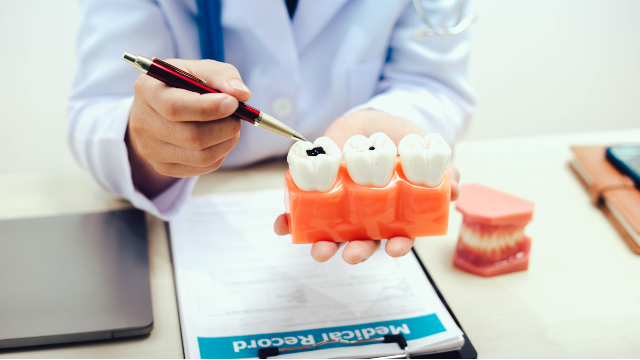
Cavity Treatment Korea: Resin Filling vs Inlay or Crown
A resin restoration is usually enough when decay is small and the tooth's walls and cusps are intact. Larger damage points to an inlay, onlay, or crown.
Learn More
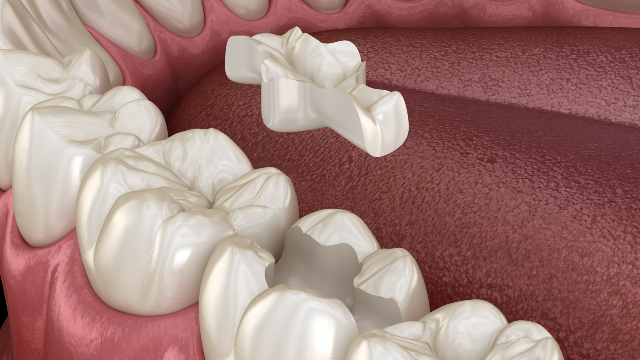
Inlay Onlay Dental Restoration vs Crown: How to Choose
An inlay or onlay restores a damaged tooth without full coverage. Published data show partial-coverage survival close to crowns, so choose by tooth left.
Learn More
Minish Dental Treatment: How It Preserves Tooth Structure
Minish dental treatment is a biomimetic restoration that rebuilds damaged teeth with precision-made blocks while removing as little enamel as possible.
Learn More